William Alexander Bridgen (1850-1920)
A life between the Bridgen and Rush families
William Alexander Bridgen was born on 7 December 1850 at 10 Palace Street, Westminster St Margaret's, the son of William Alexander and Mary Anne Bridgen formerly Cooper.

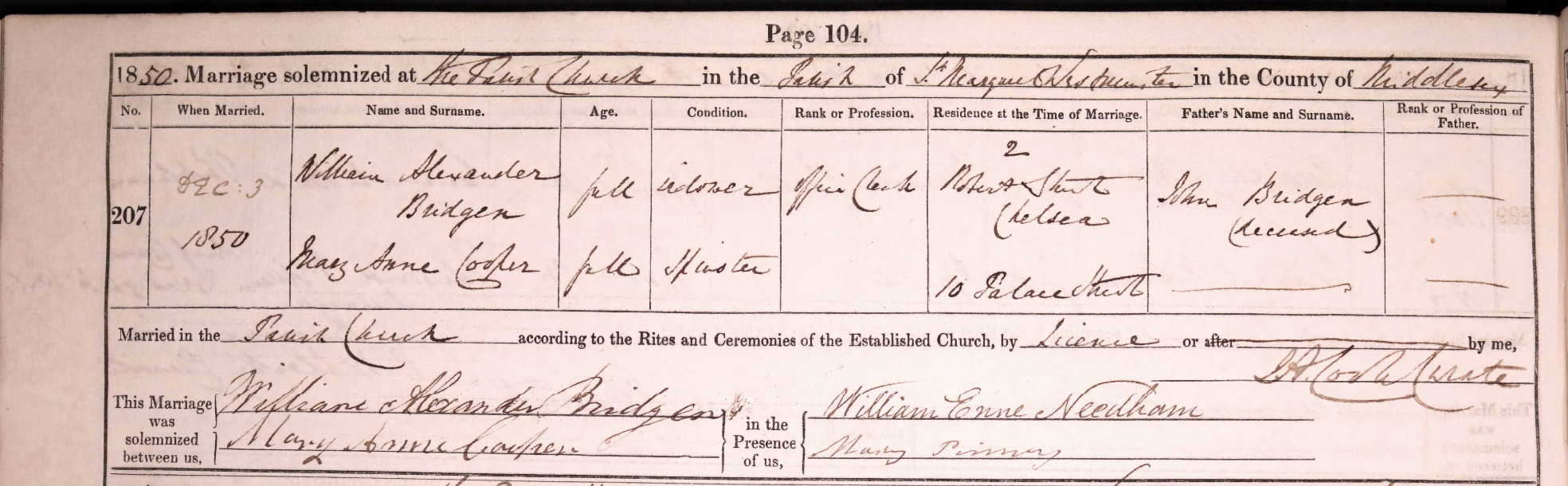
His father, born on 20 February 1784 in St Marylebone, was sixty-six when he married Mary Anne Cooper at St Margaret's, Westminster, on 3 December 1850, four days before William's birth. The marriage took place at the parish church for the address where she was living and where the child was born: 10 Palace Street, Westminster.
The original marriage register adds important detail. William Alexander Bridgen senior was a widower, an office clerk, living at 2 Robert Street, Chelsea. His father was John Bridgen, deceased. Mary Anne Cooper was a spinster, living at 10 Palace Street. Her father's name and occupation were left blank. The witnesses were William Needham and Mary Pinney. When William registered his son’s birth on 14 December, he gave his own address as 10 Palace Street, suggesting that he had joined Mary Anne there after their marriage.
The 1851 census places the new family at 9 Denbigh Street, Westminster, on 30 March 1851:
| Individual | Age | Birthplace | Occupation |
|---|---|---|---|
| William A Bridgen | 57 | St Marylebone | Clerk in Audit Office, Somerset House |
| Mary A Bridgen | 26 | St Marylebone | none recorded |
| William A Bridgen | 3 months | Westminster | none recorded |

This confirms that William senior was a government clerk at the Audit Office in Somerset House. The census gives his age as 57, but his examined 1784 baptism makes him 67, and the baptism is the better evidence. Mary Anne's age is a separate puzzle. The 1851 census gives 26, implying a birth around 1824-1825, while later Rush census returns point to 1830-1831, and her death on 4 February 1910, aged 79, supports the later range. Her census birthplaces point to one corner of London: St Marylebone in 1851 and 1901 and Paddington in 1881. The outliers are Chelsea in 1861 and St George's in the East in 1871, and both may have come from Joseph as head of the household. St George's in the East was his own birthplace, and Chelsea may reflect Pimlico, next to it, where she was living in Denbigh Street when they married.
The strongest candidate is the baptism of a Mary Ann at St Marylebone on 24 June 1830. She was born on 29 September 1828, and the family's abode was Paddington Street. Paddington Street lies in St Marylebone, by the Paddington boundary, which accounts for both her Marylebone and her Paddington answers. An 1828 birth makes her twenty-two at her first marriage, consistent with the register's "full" age, and it falls inside the range of her other recorded ages, though it matches none of them exactly. Cooper is a common surname, and no census has yet connected this family to the woman who married in 1850 and 1852.
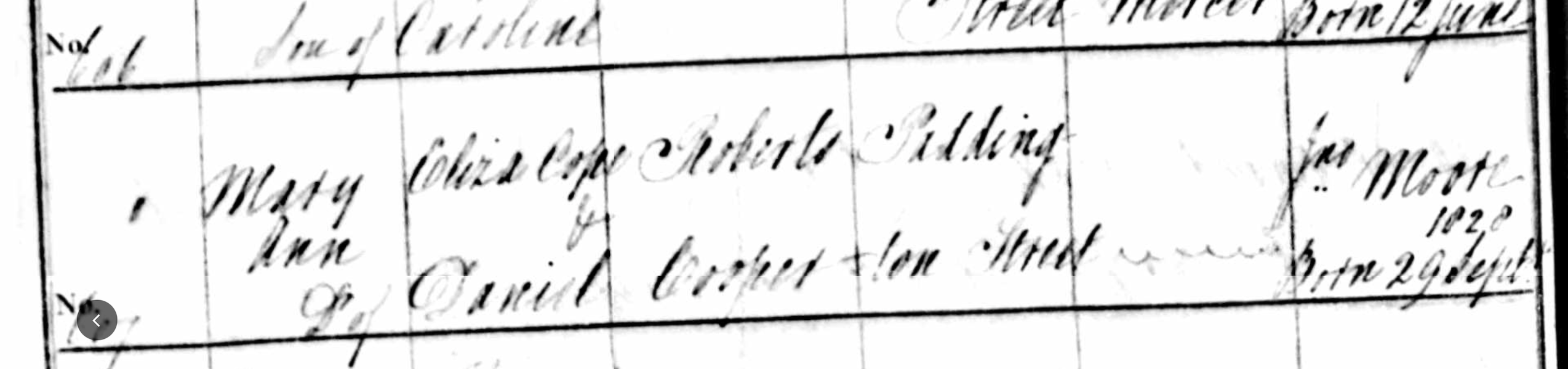
The register gives the parents' Christian names as Eliza Cope and Daniel, and enters two surnames, Roberts and Cooper, where a married couple would share one. The clerk was recording a child whose parents were not married to each other. The father's trade is left blank. Mary Ann was baptised alone, twenty-one months after her birth.
Mary Anne's father is missing from both of her marriage records. The 1850 register leaves his name and occupation blank, and so does the 1852 certificate for her marriage to Joseph Rush, which names Joseph's father. The 1850 register could have recorded a dead father as "deceased", as it did for the groom's.
If she is the Paddington Street child, the blanks have a simple explanation. Her parents were not married, she had no legal father, and she may have grown up knowing little or nothing of Daniel Cooper. A late baptism, and a child unsure of the circumstances of her own birth, would also fit the way her age moves between records. Her later ages point to 1830–31, the year of her baptism, which suggests that she, or those who answered for her, counted from the baptism rather than the birth. She signed both marriage registers in her own hand, which suggests some schooling. This is a working hypothesis. The records do not yet establish her upbringing, or that this baptism is hers.
The 1851 census for 10 Palace Street, taken after the family had moved to Denbigh Street, shows three households, the Constables, the Gerrishes and the Nicsums, and none contains a Cooper, Bridgen, Pinney or Needham. Of the witnesses to the 1850 marriage, William Needham was the local registrar of births and deaths, who registered William's birth eleven days later, and Mary Pinney was the vestry keeper at St Margaret's, as the 1851 census records. In 1841 she had kept a chandler's shop in William Street, near Palace Street. Neither witness appears to have been a relative or friend of the couple. Other marriage registers show the two signing together as witnesses for unrelated couples. Nothing yet shows why Mary Anne was living in that house.
William senior died in October 1851, before his son was ten months old, so William would have had no memory of him. That early death matters because William junior's later life cannot be understood only as a Bridgen story. Less than six months after becoming a widow, Mary Anne married into the Rush family, and William grew up in that second household.
About his father: William Alexander Bridgen (1784–1851)
William's father, William Alexander Bridgen, was born on 20 February 1784 in St Marylebone, the son of John Bridgen and Marianne Watt, who had married at St James's, Piccadilly, on 1 July 1783. He spent much of his adult life as a government clerk, eventually working at the Audit Office, Somerset House. His financial affairs also included leasehold property, ground rents, securities and obligations to several other people.
On 16 July 1804, aged twenty, he married Mary Bailey at St Andrew's, Holborn. The identification of this marriage with the later Audit Office clerk is strong, although the marriage entry itself does not supply a later address or occupation. In 1841, William and Mary lived at 18 Coleshill Street, St George Hanover Square, with Hannah Kelly, aged twenty-four, whose relationship to them is unknown. No children of this marriage have yet been securely identified.
Mary died on 12 November 1850, aged sixty-seven, at 2 Robert Street, Chelsea, after six weeks of what her death certificate called disease of brain. William was present at her death and registered it on 19 November. She was buried on 20 November. If the 1804 bride was the same Mary, the marriage had lasted more than forty-six years.
Thirteen days after Mary's burial, William married Mary Anne Cooper, who was heavily pregnant. Four days after the wedding, their son William Alexander was born on 7 December 1850. William senior was sixty-six; Mary Anne was probably twenty-two. We do not know how long they had known one another, what Mary Bailey knew, or what private arrangements preceded the remarriage.
William's paternal family was connected to the property-owning Watt family. William Watt, a gentleman associated with Walworth, explicitly called William senior his nephew and named him an executor in his will, made in 1842 and proved in 1844. The marriage of John Bridgen to Marianne Watt suggests the likely family route, although Marianne's precise relationship to William Watt remains to be independently proved. The overlapping property and annuity provisions in the two men's wills demonstrate financial connections, but not the origin of every asset.
William died on 2 October 1851, at 17 Church Square, Margate, aged sixty-eight. His death certificate records constipation of eight days and cephalitis of twenty-four hours. Margate was an established seaside resort, and a visit for rest or recuperation is a plausible explanation for his presence there, particularly after the upheavals of the preceding year. No surviving evidence yet establishes why he travelled there, whether he was ill on arrival, or whether his family accompanied him. The informant, Edward Best, head of the household at that address in the 1851 census, was present at his death. Mary Anne may have stayed in London with their ten-month-old son, which would explain why someone else registered the death.

William senior left his son the Bridgen name and an eventual interest in property, but no chance to know him. In 1853, Mary Anne and Joseph Rush, by then married, were named in two cases about the Watt estate in the Court of Chancery, the court that dealt with disputes over wills, trusts and inheritances. The claims and outcomes are not yet known, but the proceedings show that the financial network around William senior remained relevant after his death.
His father's will and the problem of inheritance
William Alexander Bridgen senior's will, dated 26 August 1851 and proved on 25 October 1851, is an important document in the story. It identifies him as formerly of No. 2 Robert Street, Chelsea, then of No. 9 Denbigh Street, Westminster, and of the Audit Office, Somerset House.

The manuscript preserves a curious small correction. Mary Anne was initially named as “my dear wife Mary Anne Cooper”; “Bridgen formerly” was inserted above the line to give her married name and former surname. It may have been no more than a drafting oversight, but the manuscript briefly preserves the identity by which she had been known before their marriage, barely nine months earlier. We cannot know whether William dictated that wording or a clerk drafted it.

The main provision concerned leasehold property in Walworth: 28 and 29 Amelia Street, 1, 2 and 3 Church Street, a small tenement with house and premises in Church Street, and ground rents on property in Amelia Street. Mary Anne was to have it for life, or for as long as William senior's interest lasted. After her death it was to pass to his son William Alexander Bridgen, subject to specified payments.
For William junior's biography, the Watt connection matters because it suggests the financial world behind his father's will. The property, annuities and obligations may belong to a wider Watt-Bridgen network and not simply to an Audit Office clerk's savings. That does not prove William Watt was the source of William senior's income or property, but it is a credible route for some of it.
The will's phrase "sums so due" suggests that at least some payments were debts or earlier obligations rather than gifts.
The will also names several people and obligations that have not yet been traced. The clearest example is Harriet Thomson, who was to receive an annuity of twenty pounds a year for life. Deeds for the Walworth leaseholds are a further lead. The people named in the will and the research they call for are set out in William Alexander Bridgen (1784–1851): Family Circumstances and Estate Disputes.
How the will may have affected William's life
The will named William Alexander Bridgen as William senior's son and intended heir. Mary Anne was to have the leasehold property for life, with William succeeding only if those interests still existed. He inherited nothing immediately and grew up dependent on his mother and the household she formed with Joseph Rush.
The property was subject to payments and other obligations whose effect on its value remains uncertain. Mary Anne’s provision may have helped support the household, but no accounts or subsequent property records have yet established how much income it produced.
Mary Anne died on 4 February 1910, when William was fifty-nine. The 1910 valuation entry for 29 Amelia Street names the Trustees of the Yates Estate as owner, on a lease of 59¾ years from 29 September 1904, with the Ecclesiastical Commissioners as superior interest. Similar entries run across that range of numbers, and none names a Bridgen. By 1904 No. 29 at least was held on a new lease, and the 1910 entry names no Bridgen. This suggests the earlier lease had ended or been sold, though how it left the family is not recorded. No entry has been found for 28 Amelia Street, and no Church Street numbers 1, 2 or 3 appear in the valuation; a “New Church Street” is listed, but without those numbers. Nothing in the 1910 records shows any part of his father’s property passing to William.
Mary Anne's remarriage to Joseph Rush
On 20 March 1852, less than six months after William senior's death and fifteen months after her first marriage, Mary Anne Bridgen, nee Cooper, married Joseph Rush.
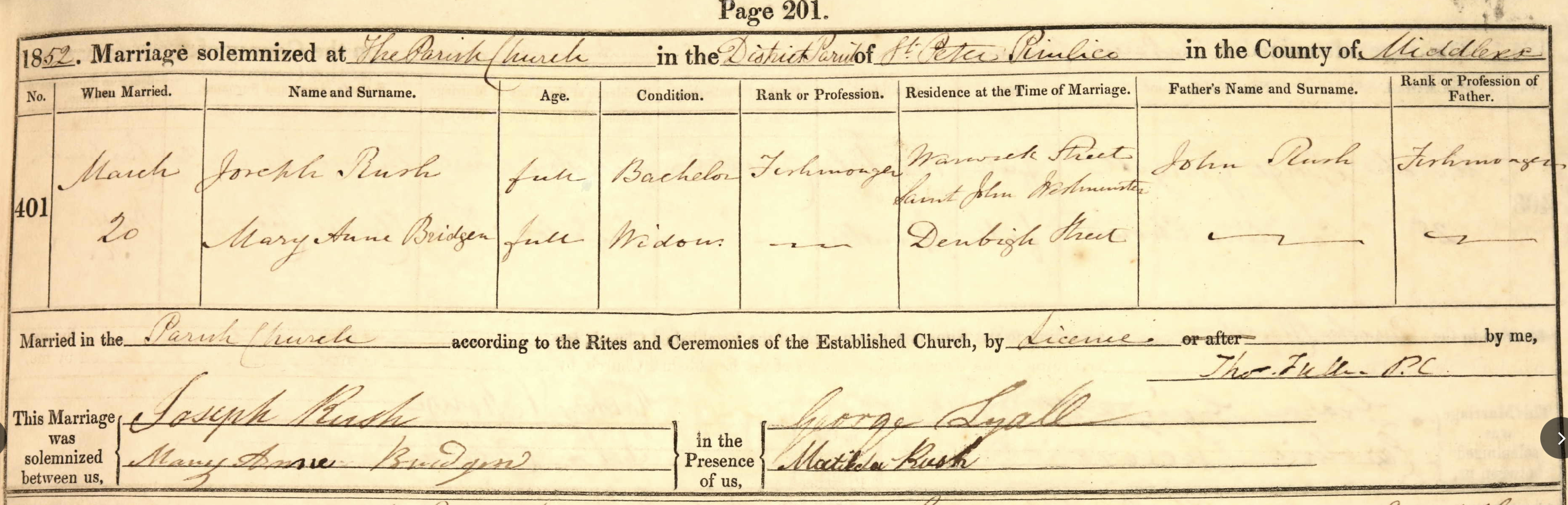
The marriage certificate records:
- Joseph Rush, bachelor, fishmonger, living in the parish of St John, Westminster
- Joseph's father: John Rush, fishmonger
- Mary Anne Bridgen, widow, living in Denbigh Street, St Peter, Pimlico
- Witnesses: George Lyall and Matilda Rush
This establishes that William's stepfather was a fishmonger and that Joseph's own father was one too. Fishmongering was already in the Rush family before William entered it.
Mary Anne's father is not recorded here either. This is the second certificate in two years that leaves him blank, while Joseph's father, John Rush, is named on this one. Taken with the 1850 register, it makes it more likely that she did not know or would not name her father, which the Paddington Street baptism, with its unmarried parents, would explain.
William was fifteen months old when Joseph Rush became his stepfather, and Joseph may have been the only father he remembered. Mary Anne and Joseph went on to have a large family, which gave William maternal half-siblings. The reported children include:
- Joseph George Rush (born about 1853, died 1918)
- Frederick Charles Rush (born about 1854, died 1945)
- George James Rush (born about 1859, died 1937)
- Mary Annie Rush (born about 1861, died 1939)
- Elizabeth J. Rush
- Emily Alice Rush; possibly the Alice recorded in 1871
- John Henry Rush; possibly the John recorded in 1871
Some of these half-brothers later became important to the fishmongering story.
The 1861 census: William as "William Rush"
In the 1861 census the household was living at the Prince of Orange public house, 118 Lower Road, Rotherhithe, Surrey. Joseph Rush was recorded as the head of household and a publican. The Prince of Orange had opened in 1859 as a beerhouse, licensed to sell beer only, and did not gain a full licence until 1874. It stood opposite one of the entrances to the Commercial Dock. The Rush family, still in Shoreditch in the spring of 1859, were among its earliest keepers and may have been the first. The household included:
| Person | Age | Notes |
|---|---|---|
| Joseph Rush | 31 | Head, publican, William's stepfather |
| Mary A. Rush | 31 | William's mother |
| William Rush | 10 | Almost certainly William Alexander Bridgen, recorded under his stepfather's surname |
| Joseph Rush | 8 | Maternal half-brother |
| Frederick Rush | 6 | Maternal half-brother |
| George Rush | 2 | Maternal half-brother |
| Infant child | 2 weeks | Now known to be Mary Annie Rush |
| Martin Frist | 51 | Relationship unknown (Fish salesman) |
| Elizabeth Webster | 29 | Relationship unknown |
| George Lyall | 45 | Servant, widower, potman; witness at the 1852 Rush marriage |

The ten-year-old "William Rush", listed as the "Son" of the head of household, matches William Alexander Bridgen, born in December 1850. He appears with Mary Anne, Joseph and the younger Rush children, so he was raised in the Rush household and was at least once formally recorded under its surname.
The enumerator may simply have used the household surname for the child, or William may have been known as William Rush in ordinary family life. The record does not say which. It does show that Bridgen was not the only name attached to him in childhood.
Joseph Rush was a fishmonger in 1852, a publican in 1861 and a fishmonger again in 1871. Even at the Prince of Orange the fish trade was in the house: the lodger Martin Frist was a fish salesman. Joseph's father John was a fishmonger, and later records show William and at least two of his Rush half-brothers in the trade.
George Lyall, a witness at Joseph and Mary Anne's wedding in 1852, was still with the family nine years later as their potman (general bar assistant) in the Prince of Orange.
The 1871 census: two fishmongers' households
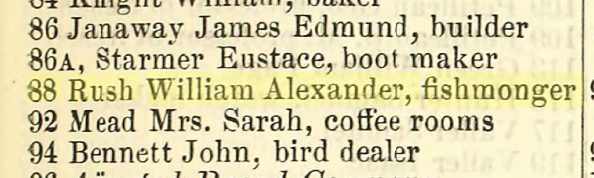
The 1871 census places Joseph Rush, aged 40 and working as a fishmonger, at 88 Larkhall Lane, Lambeth. His wife Mary was 40. Their children in the household were Frederick, 16; George, 12; Ann, 10; Elizabeth, 8; Alice, 6; and John, 4, with Alice and John continuing onto the next census page. William, who appeared as William Rush in 1861, is absent from the household, so by twenty he was living elsewhere.

There is a tantalising possibility, which can never be proven, that the Rush shop had a famous customer. In 1873–74 Vincent van Gogh, then twenty and working for the art dealers Goupil & Cie, lodged at 87 Hackford Road, about a mile from Larkhall Lane, and the family may have served the young artist (who is known from his letters to have enjoyed fish!).
A separate 1871 entry at Newington Butts, Newington, St Saviour Southwark records John Cobb, 41, a fishmonger and poulterer, born in Chelsea, and his wife Mary Anne Cobb, 37, also born in Chelsea. Their servant William Rush, 20, was recorded as a fishmonger, born in Pimlico. The street number appears to be 103 Newington Butts.

The absence from Joseph's household makes the Newington Butts entry more persuasive. William Rush has the right first name, age and Pimlico birthplace, uses the surname recorded for William in 1861 and works in the Rush family trade, so he is very likely William Alexander Bridgen. The later directory listing of William Alexander Rush, fishmonger, at Joseph's Larkhall Lane address (below) strengthens the identification.
On that identification, William's fishmongering is documented by 1871, eighteen years before the 1889 marriage certificate. The census calls him a servant and fishmonger in Cobb's household. It does not establish an apprenticeship or identify Cobb as his master, and a business or family link between Cobb and Joseph Rush is possible but unshown.
The fish trade as a family inheritance
William Alexander Bridgen almost certainly entered fishmongering through the Rush family. The evidence is cumulative:
- His stepfather Joseph Rush was a fishmonger when he married Mary Anne in 1852.
- His step-grandfather John Rush was also a fishmonger.
- William was raised from early childhood in Joseph Rush's household.
- In 1861, William was recorded as William Rush.
- A strong candidate for William appears as William Rush, fishmonger, in John Cobb's Newington Butts household in 1871.
- In 1880, William Alexander Rush, fishmonger, was listed at 88 Larkhall Lane, Joseph's 1871 address and William Bridgen's 1881 address.
- His maternal half-brothers Joseph George Rush and Frederick Charles Rush were in the fish trade by 1911 (below).
- William himself became a fishmonger, then a master fishmonger, employer, self-employed fishmonger and finally fishmonger and shopkeeper.
No apprenticeship record has been found, so we cannot say who trained him or whether Cobb had any connection to the Rush business. William's working life followed the trade of the family that raised him.
By 1911, at least three sons of Mary Anne Cooper were working in the fish trade:
| Person | Relationship | 1911 evidence |
|---|---|---|
| William Alexander Bridgen | Son of Mary Anne Cooper and William Bridgen senior | Fishmonger, own account, at 18 Bankton Road, Emily assisting |
| Joseph George Rush | Maternal half-brother | Fish dealer, Billingsgate, living at 1 Northfield Road, East Ham |
| Frederick Charles Rush | Maternal half-brother | Fish salesman, own account, living at 16 Brading Road, Lambeth |
Joseph George Rush's 1911 census entry places him at 1 Northfield Road, East Ham, with wife Florence and children including Mary Annie, Ernest, Ruby and Ethel Grace. His occupation was recorded as Fish Dealer, Billingsgate. He and Florence had been married thirty years, with twelve children, eight living.
Directory listings inspected for 1885 to 1915 give Frederick Charles Rush, fish salesman, a business address at Billingsgate Market. His home in the 1911 census was 16 Brading Road, Lambeth, where he was recorded as working on his own account.
This cluster is strong evidence of a family trade. William was part of a Rush-Bridgen network in which fish dealing, fish sales and fishmongering recur.
Whether the brothers worked together, supplied one another, shared premises, or operated independently remains uncertain.
First marriage: Eliza Emma Chesson
William married Eliza Emma Chesson on 9 May 1875 at St Barnabas, South Kennington, Surrey. The marriage was witnessed by his mother and half-brother.
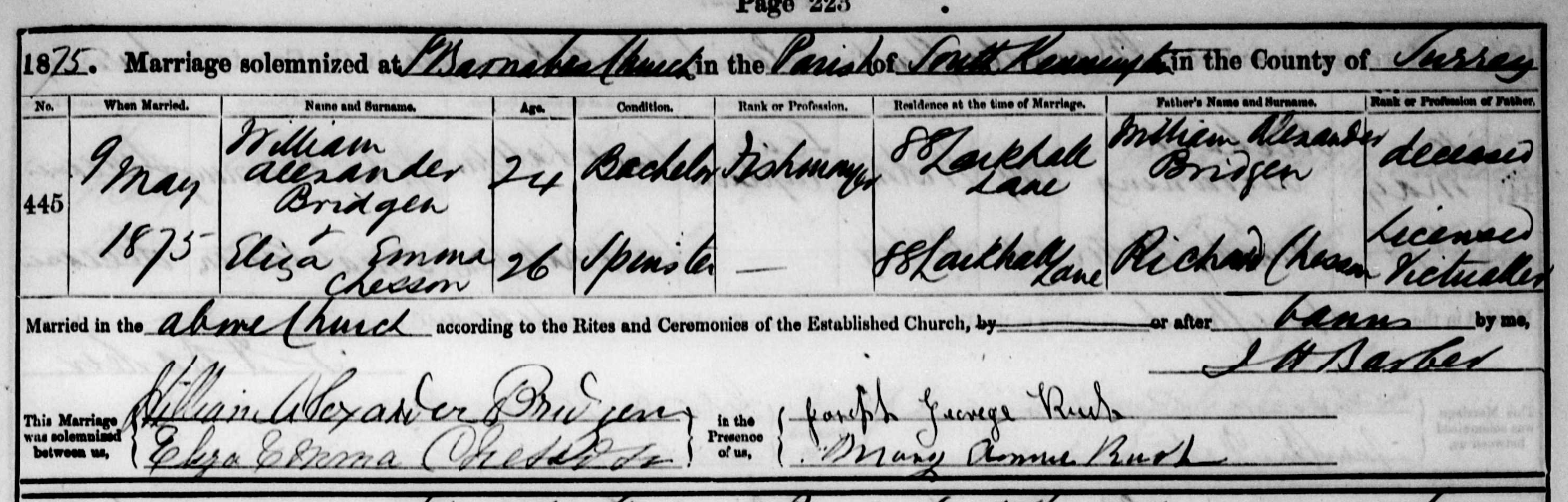
Eliza was born about 1849 in Leysdown, Kent. William was by then using the surname Bridgen in official family records.
William and Eliza had five known children:
- Eliza Eleanor Bridgen
- William Alexander Bridgen
- Joseph Alfred Bridgen
- Julia Annie Bridgen
- Mary Isabella Bridgen
The 1881 census records William Bridgen, fishmonger, at 88 Larkhall Lane, Lambeth, with his children Eliza (4) and William (3).

An 1880 directory lists "Rush Wm. Alex. fishmonger, 88 Larkhall la." Joseph Rush had lived at that address in 1871 and died in 1882. The distinctive name, trade and address, together with William Bridgen's appearance there in 1881, make this the clearest evidence that William used both surnames. They also suggest continuity in the family fish trade at the address in the years around Joseph's death, though not how Joseph and William shared the work.
Eliza died at 10 Jelf Road, Brixton, aged 38, on 3 October 1887. Her death certificate gives the cause as morbus cordis and anasarca, heart disease with the swelling it causes, and records William as present at her death. The cause was certified by G. W. Burn, MRCS. William registered the death the next day, and the certificate describes Eliza as the wife of William Alexander Bridgen, fishmonger.

Second marriage: Emily Cooper
William married Emily Cooper on 29 August 1889 at St Mary's Church, Lambeth, Surrey.
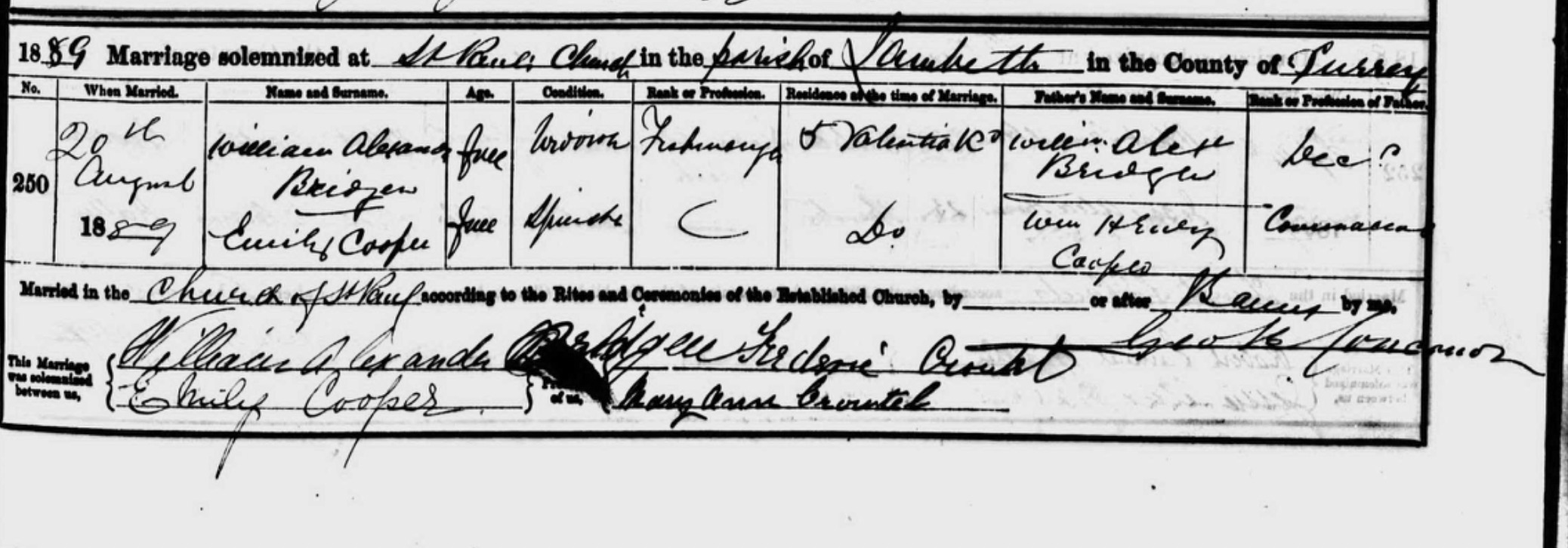
The marriage certificate records:
| Field | Detail |
|---|---|
| Groom | William Alexander Bridgen |
| Marital status | Widower |
| Occupation | Fishmonger |
| Residence | 5 Valentia Road, Brixton, Lambeth |
| Groom's father | William Alexander Bridgen, deceased |
| Bride | Emily Cooper |
| Marital status | Spinster |
| Bride's residence | Same address |
| Bride's father | William Henry Cooper, carman |
Valentia Road was in Brixton, near Atlantic Road, Pope's Road and Brixton railway station. It later disappeared through redevelopment.
The 1889 marriage certificate independently confirms William's fishmongering occupation under the Bridgen name.
William and Emily had five known children:
- Emily Ivy Bridgen
- Harold Bridgen
- Alice Nora Bridgen
- Gertrude Doris Bridgen
- Elsie Marjorie Bridgen
Across his two marriages, William had ten known children.
The family tragedy of 1900
In 1900, William and Emily suffered the deaths of their twin daughters, Gertrude Doris Bridgen and Alice Nora Bridgen, within five days of each other.
The death certificates record the family at 99 Geneva Road, Lambeth and describe William as a Master Fishmonger.
Gertrude Doris Bridgen died on 19 August 1900. Her certified cause of death was gastro-enteric syncope. Alice Nora Bridgen died on 24 August 1900. Her certified cause of death was teething, diarrhoea (five days) and convulsions.
By 1900 William was approaching fifty. He had lost his father in infancy and his first wife, remarried, and built a working life in the fish trade. The deaths of twin daughters within five days would have been a severe blow.
The certificates are also occupational evidence. "Master Fishmonger" suggests status and independence in the trade, not merely wage labour.
1901: fishmonger and employer
In the 1901 census, William was living at 99 Geneva Road, Lambeth and was recorded as a fishmonger and employer.

The census distinguishes employers from people employed by others, so William was running a business that employed others. It gives no workplace address. The directory evidence below places his shop at 51 Atlantic Road, a short walk from Geneva Road.
1900–1908: William Rush at Atlantic Road
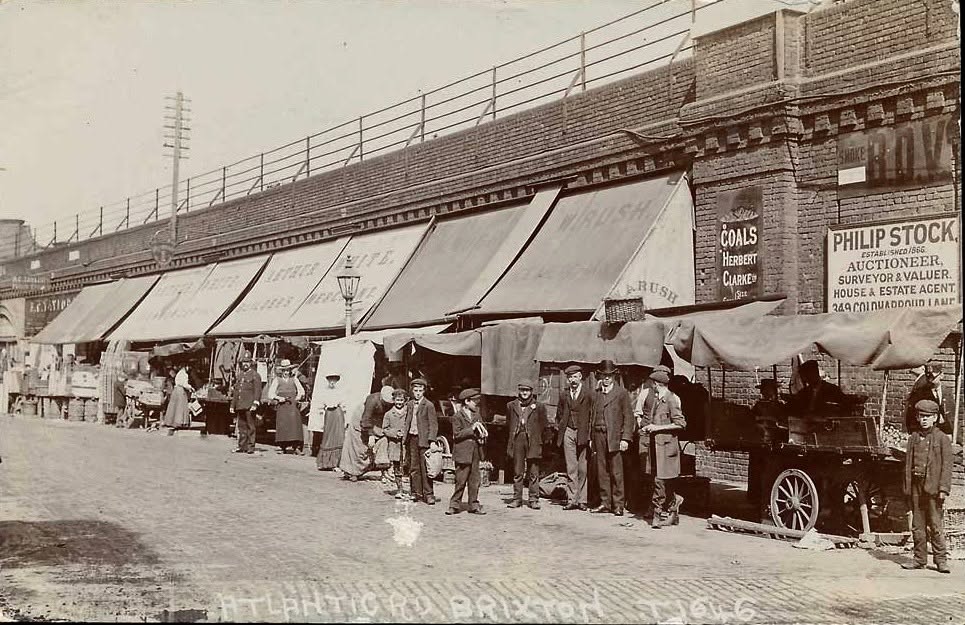
The photograph (found on a Brixton history Facebook group) shows W. A. RUSH on the awning of a shop beneath the Atlantic Road railway arches, beside Arthur White's builders' merchants. The 1900 Post Office directory places White at 47 and 49 Atlantic Road and William Rush, fishmonger, at 51. Of the directories checked so far, 1900 is the only one in which both businesses appear together, which makes it the best guide to the photograph's date. Together they point to this being William Alexander Bridgen's fish shop, trading under the name W. A. Rush.
Brixton was then one of south London's busiest shopping districts, home to Bon Marché, described as the first purpose-built department store in the country, and Electric Avenue, among the first shopping streets lit by electricity. Brixton Market had begun on Atlantic Road in the 1870s, and around 1900 street traders lined the road, with shops let beneath the railway arches. The area also had a bohemian side: Dan Leno lived in Akerman Road, the young Charlie Chaplin in Ferndale Road, and Fred Karno's "Fun Factory" stood off Coldharbour Lane.
William Rush remains listed as a fishmonger at 51 Atlantic Road in 1904, 1906 and 1908.

The address had an earlier family connection. An 1880 directory lists Joseph Rush, fishmonger, at number 51 (either Joseph senior or his son Joseph George) and Wm. Alex. Rush, fishmonger, at 88 Larkhall Lane, where the 1881 census records William as William Bridgen. With the photograph, these records show that Rush was an established trading name for William, and more than an occasional census variation.
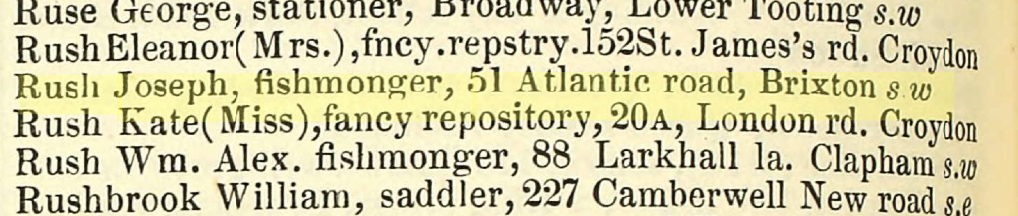
The address also fits William's known movements within Brixton. 51 Atlantic Road is roughly five minutes' walk from the former Geneva Road area, where he lived in 1901, and from Bankton Road, where he lived by 1911. That proximity adds weight to identifying the directory's William Rush with William Bridgen.
1910–1911: 18 Bankton Road and a family business
The 1910 valuation
The 1910 Lloyd George Domesday valuation for 18 Bankton Road records:
| Field | Entry |
|---|---|
| Address | 18 Bankton Road |
| Description | Private house |
| Occupier | W. A. Rush |
| Owner | W. A. Bridgen |
| Owner's interest | Leasehold |
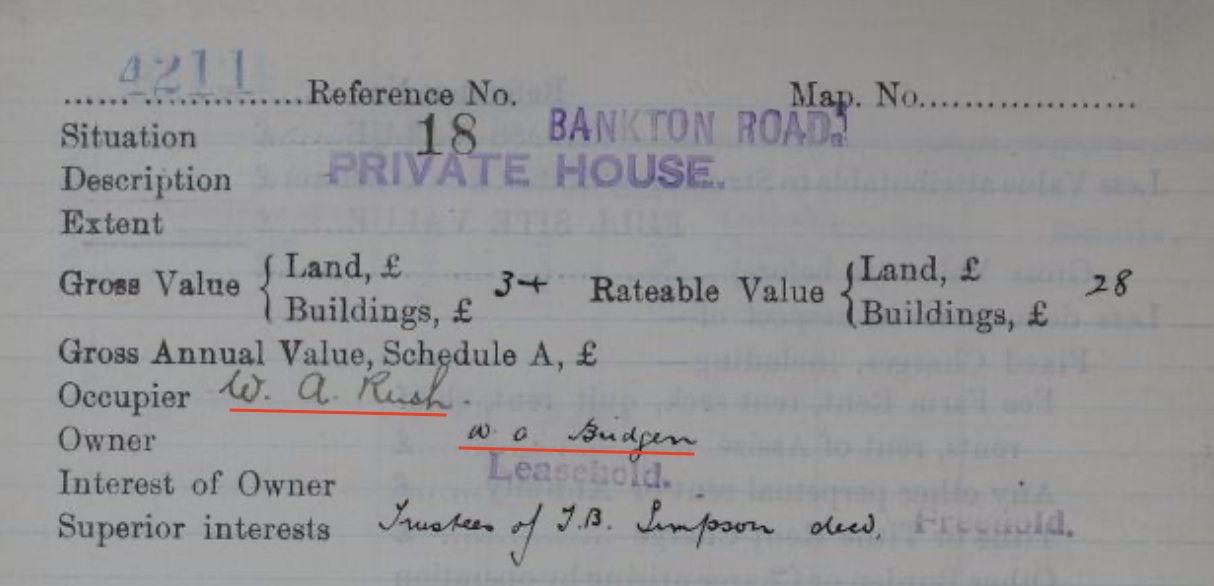
The document records W. A. Rush as occupier and W. A. Bridgen as leasehold owner of the same private house. No separate W. A. Rush has been identified in the Rush family, and the 1911 census (below) independently places William Alexander Bridgen at this address.
The natural reading is that both entries refer to William Alexander Bridgen, who appears as Rush in some records and Bridgen in others. The valuation puts his two surnames side by side at his own home. It does not say why the occupier and owner fields differ.
The 1911 census
By 1911, William and Emily were living at 18 Bankton Road, Brixton.

The census describes William, then about sixty, as a fishmonger, own account, meaning self-employed, and Emily as assisting in business. The "whether working at home" field was blank, so the business was probably run from a shop elsewhere.
The change from "employer" in 1901 to "own account" in 1911 may indicate that William's business had become smaller, or that he no longer employed staff. It might also reflect a temporary change or a difference in how the census was filled in.
The RUSH fish shop at 159 Battersea Park Road
This photograph was found attached to a Rush Family Tree on Ancestry.com and downloaded.
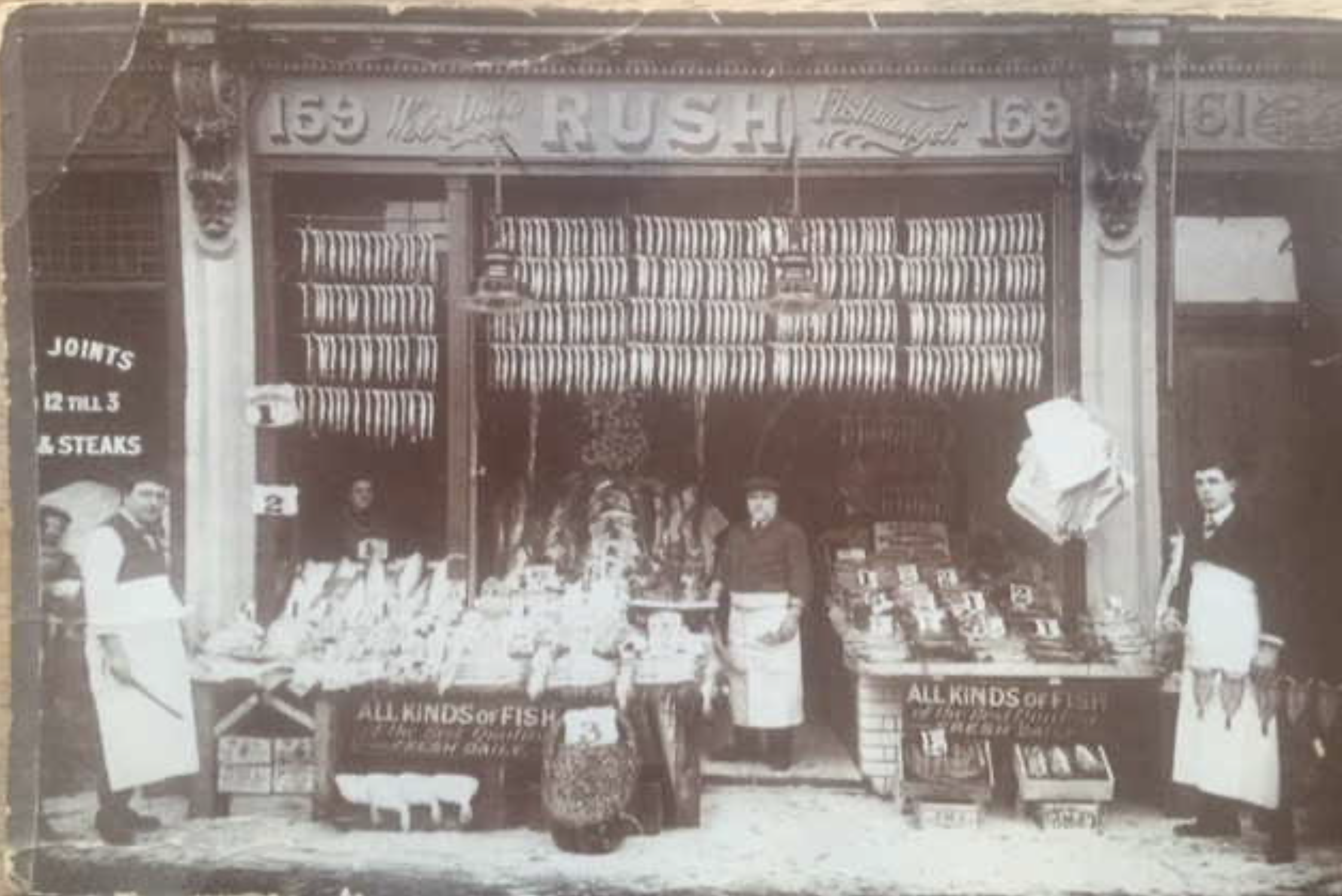
The photograph shows a fish shop whose sign reads 159 Wet and Dry RUSH Fishmongers 159, with several people outside and inside, including an older man and a woman. "Wet" fish was fresh and "dry" fish was cured, salted or smoked, so the shop sold both.
The photograph does not name the people shown. The candidates for the older man and woman are discussed in the postscript.
The building
William Alexander Bridgen died at 159 Battersea Park Road in January 1920, and the photograph shows a fish shop numbered 159. A comparison of the decorative architecture shows a match between the historical shopfront and the surviving building.
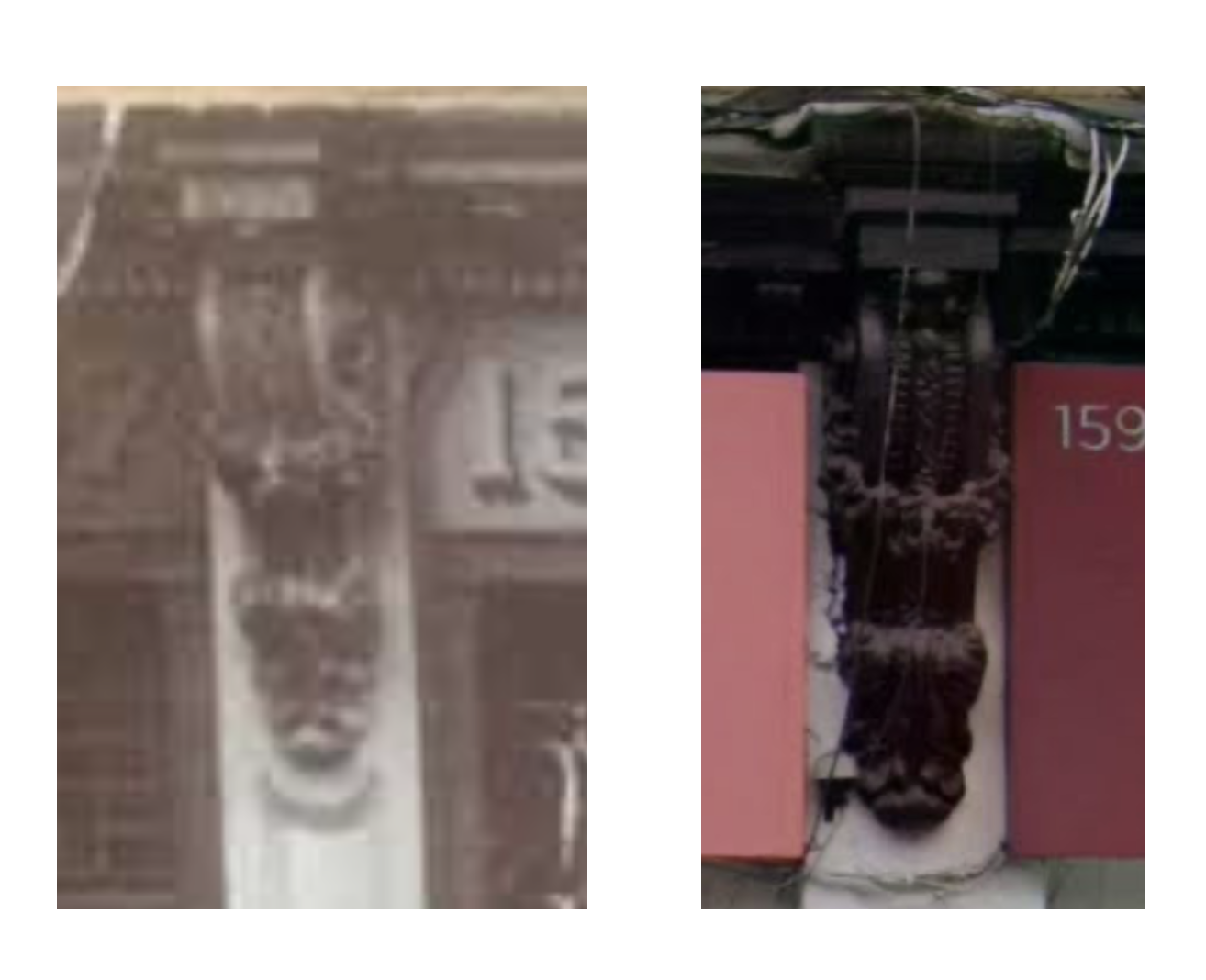
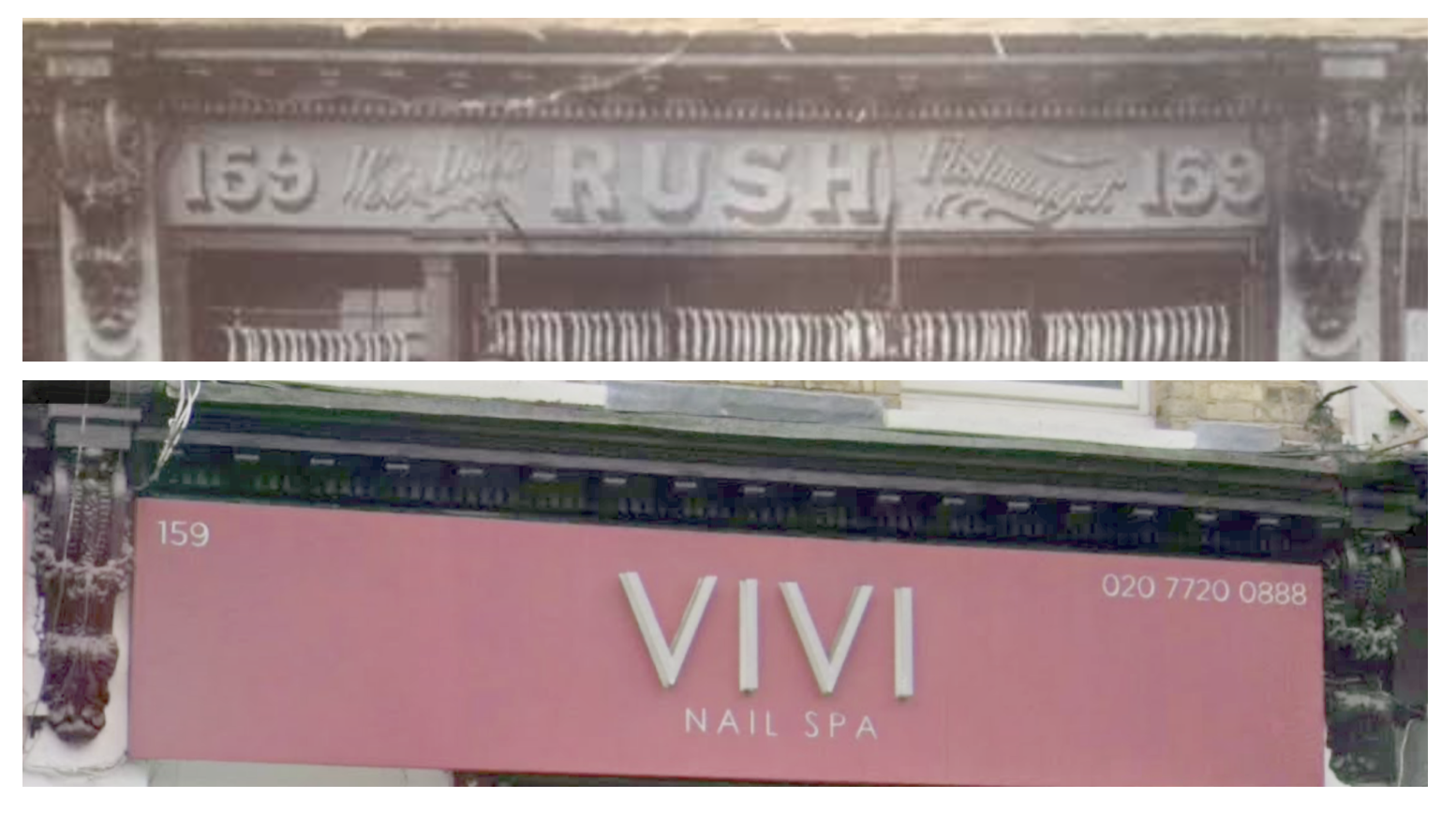
The comparison focused on the ornate pilasters and shopfront arrangement:
- The same decorative capitals
- The same elongated central ornament
- The same lower floral or scroll-like termination
The identification of the photograph as 159 Battersea Park Road is almost certain.
The shop stood on a busy main road through working-class Battersea. The railways had swelled the district from about 6,000 people in 1840 to 168,000 by 1910, most of them in terraced streets built for railway and industrial workers, and Battersea Park Road was lined with churches, chapels and shops.
Dating the shop
The Ancestry description associated the photograph with Joseph Rush and William Alexander Bridgen and dated it to around 1910. That date does not fit. The shop was a fishmonger's before the Rushes: William Patrick Corkery was there in the 1901 and 1911 censuses, and the 1910 Lloyd George valuation describes the premises as a house and shop held on a 21-year lease from Christmas 1895, which would have expired around Christmas 1916. The occupier's name reads as W. E. Corkery, an uncertain reading that matches him. A shop trading as RUSH is therefore unlikely to date from his time, unless his business traded under that name, for which there is no evidence.
| Year | Fishmonger at 159 Battersea Park Road |
|---|---|
| 1901 | William Patrick Corkery |
| 1910 | Corkery (21-year lease from Christmas 1895) |
| 1911 | Corkery, fishmonger and employer, working at home |
| 1919 | Frederick Rush |
| 1920 | William Rush; William Alexander Bridgen dies there, fishmonger and shopkeeper |
| 1921 | No entry for number 159 yet located in the census |
| 1922 | Mrs Emily Rush |
| 1925 | Mrs Emily Rush |
| 1940 | William Joseph Munden |
The 1919 and 1920 directories
Frederick Rush appears in the 1919 Post Office London County Suburbs Directory in two places. The Commercial Directory section, page 413, lists:
Rush Frederick, fishmonger, 159 Battersea Park road SW8.
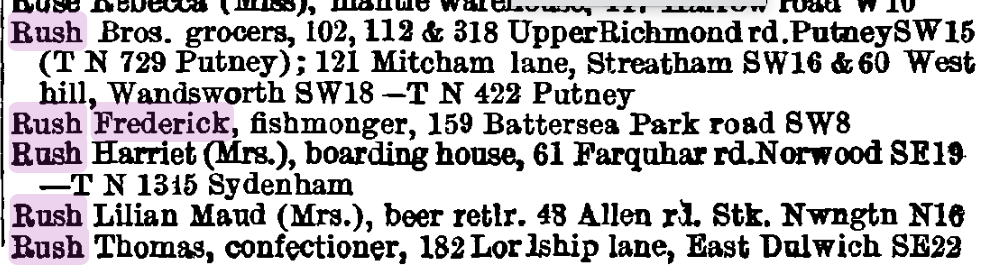
The Fishmongers section of the trades directory for the same year also lists him at 159 Battersea Park Road. The entry is therefore not an address-listing accident or a stray index result: Frederick appears both as a named commercial entry and under the trade itself.
| Directory evidence | Detail |
|---|---|
| 1919 Commercial Directory, page 413 | "Rush Frederick, fishmonger, 159 Battersea Park road SW8" |
| 1919 Fishmongers Trades Directory, page 510 | Frederick Rush again listed at 159 Battersea Park Road |
The original printed page identifies the directory as Commercial Directory, 1919. The information may have been gathered before publication, so the entry shows Frederick was listed there by 1919, not necessarily that he first arrived that year.
His half-brother Frederick Charles Rush (above) is the likeliest identification. The 1919 directory gives no second forename or relationship, and its commercial listing does not place Frederick's home at the shop. Why it lists him at 159 in 1919, when the 1920 edition lists William, remains open.
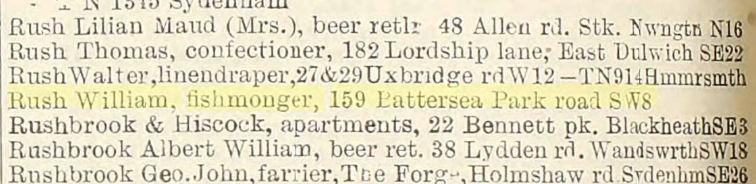
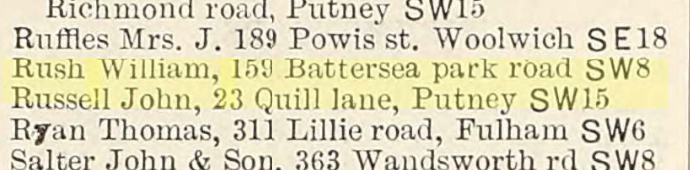
The 1920 directory lists "Rush William, fishmonger, 159 Battersea park road SW8" in its alphabetical section and again under Fishmongers. William Alexander Bridgen died at 159 in January 1920, and his death certificate calls him a fishmonger and shopkeeper. The name, trade, address and date identify the directory's William Rush with him. Frederick's 1919 entry remains part of the business history, though his role is unknown.
William's death at 159 Battersea Park Road
William Alexander Bridgen died on 10 January 1920 at 159 Battersea Park Road, Battersea, aged 69.

His death certificate records:
| Field | Detail |
|---|---|
| Date of death | 10 January 1920 |
| Place of death | 159 Battersea Park Road |
| Age | 69 years |
| Occupation | Fishmonger, Shop-keeper |
| Cause of death | Rupture of cerebral blood vessel, 29 hours; coma |
| Informant | E. Bridgen |
| Informant's relationship | Widow of deceased present at death |
| Informant's address | 159 Battersea Park Road, Battersea |
| Registration date | 12 January 1920 |
William and Emily lived at the premises when he died, and the certificate's description of him as fishmonger and shopkeeper matches the 1920 directory listing of William Rush at the same address.
Together they make a strong case that William ran the fish shop at 159 under the Rush name. They do not show whether he owned the premises or on what terms he held them.
No occupier has yet been found for 159 Battersea Park Road in the 1921 census. That leaves the household's position in 1921 unclear, but does not show that the shop closed after William's death.
William was buried in West Norwood Cemetery.
Postscript
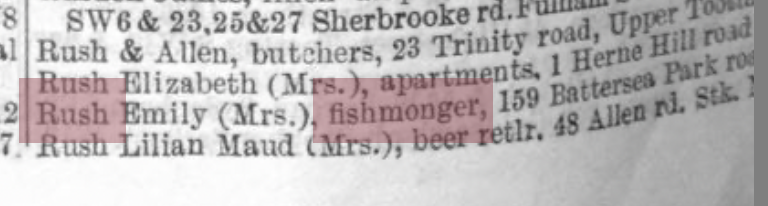
The 1922 and 1925 Post Office Directories list "Rush Emily (Mrs.), fishmonger" at 159 Battersea Park Road. She was very likely William's widow, Emily Bridgen, who lived there when he died in 1920 and had assisted in his fish business in 1911. Two other Rush women can be set aside: William's half-sister Emily Alice Rush married Richard James William Harris in 1886, and Frederick Charles Rush's wife was Fanny in the 1911 census.
The directories suggest that Emily continued the fish business under the Rush name after William's death. They also support, without proving, the identification of William and Emily as the older man and woman in the RUSH shop photograph. They lived at 159, Emily had assisted in William's business in 1911, and the 1920, 1922 and 1925 directories list a Rush there. The photograph itself names no one, and Frederick's 1919 listing leaves his part in the business open.
Keeping the Bridgen name
William Alexander Bridgen senior was sixty-six when his son was born and died before the boy was ten months old. No children from his 1804 marriage to Mary Bailey have been identified, so William junior is the only known son to carry the name forward.
He did not grow up with it. He appears as William Rush in his stepfather’s household in 1861 and very likely under that name as a working fishmonger in 1871. In 1880 he is Wm. Alex. Rush at 88 Larkhall Lane, where the 1881 census has William Bridgen. Directories list William Rush, fishmonger, at Atlantic Road in 1900, 1904, 1906 and 1908 and at 159 Battersea Park Road in 1920, and the 1910 valuation puts W. A. Rush and W. A. Bridgen at one address. Counting the 1871 identification, Rush is attached to his working life for nearly fifty years.
Bridgen is the name he used when it was written down for the record. He married as Bridgen in 1875 and 1889, named William Alexander Bridgen as his father on the 1889 certificate, and gave the name to all ten of his known children. Nothing in his circumstances required it. His father was dead, no property is known to have come to him, and the household and trade that raised him were Rush. After his death the 1922 and 1925 directories listed Mrs Emily Rush, fishmonger, at the shop where they had lived, so Rush stayed with the fish business and Bridgen stayed with the family.
The name passed to his sons William, Joseph Alfred and Harold.
A dated chronology is in william-alexander-bridgen-chronology.md.